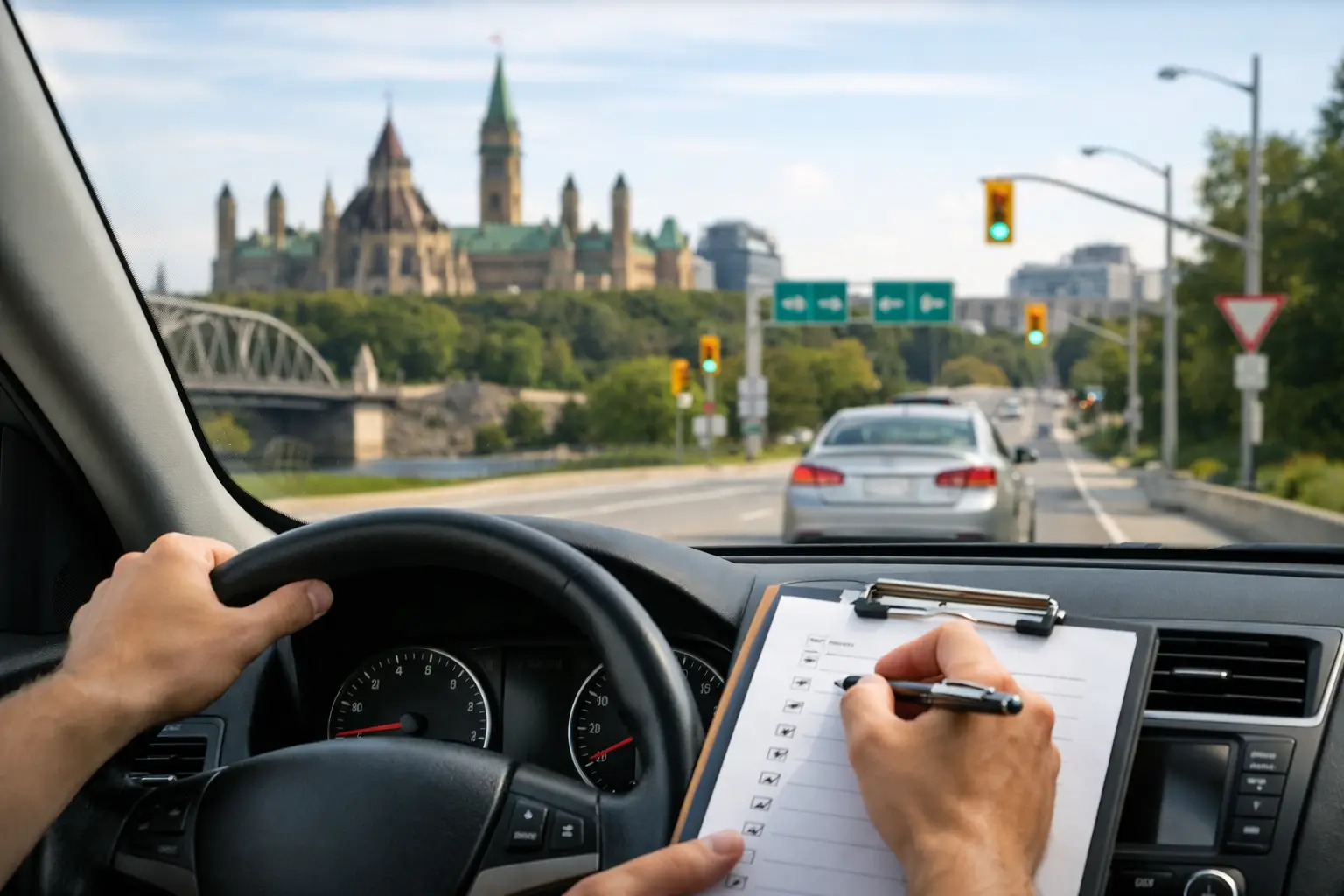
The biggest surprise on test day is usually not the route. It is how quickly small habits show up under pressure. A solid Ottawa G2 test route guide helps, but the real advantage comes from knowing why certain spots are used and what the examiner is trying to see from you in each section.
If you are preparing for your G2 road test in Ottawa, think of the route as a skill check, not a memory game. Examiners are not looking for perfect local knowledge or robotic driving. They want to see safe decisions, steady control, and good awareness in real traffic. That is why students who only memorize turns often get caught off guard, while students who understand the patterns behind the route usually perform better.
How to use this Ottawa G2 test route guide
Most Ottawa G2 test routes are designed to cover the basics in a short time. You can expect a mix of quiet residential streets, busier roads, intersections, lane changes, and parking lot movement at the beginning or end. The exact route may change depending on traffic, construction, weather, or examiner choice, so no guide should be treated like a script.
What you should expect is repetition in the skills being tested. You will likely need to show clean right and left turns, proper stopping at signs and lights, speed control, mirror checks, blind spot checks, lane changes, and parking. In some cases, you may also be asked to do a roadside stop, a three-point turn, parallel parking, or reverse parking. Not every examiner uses the same sequence, but the scoring focus stays consistent.
A route guide is most useful when it helps you practice the pressure points. That means identifying where students tend to roll stops, speed up too early, drift wide on turns, or miss school zone and community safety signs. Ottawa has plenty of roads where the test feels easy until one rushed decision costs valuable marks.
What examiners usually look for on Ottawa G2 routes
The examiner is not trying to trick you. They are watching whether your habits are safe enough for independent driving. That starts before you even leave the parking area. If you forget to adjust your seat, miss a mirror check, or move without proper observation, the test starts on weak footing.
Once you are on the road, your observation matters as much as your control. A smooth turn means less if you did not scan the intersection properly. A clean lane change means less if you signaled late or missed a blind spot check. Many students focus hard on steering and speed, but the test is really about decision-making. Your examiner wants to see that you notice hazards early and react calmly.
Consistency also matters. One strong turn does not cancel out three weak stops. One perfect lane change does not make up for rushing through a school area. The strongest test drives look steady from start to finish. They are not flashy. They are predictable, safe, and calm.
Common road features that appear on a G2 test route
In Ottawa, many G2 routes include residential areas because they reveal a lot about a driver’s habits. These roads test your ability to manage lower speed limits, parked cars, hidden driveways, pedestrians, and all-way stops. Students often underestimate residential driving because it feels simple. In reality, this is where rushed observation and poor speed control stand out the most.
You may also be taken onto larger collector roads or multi-lane streets. This part of the route usually tests lane discipline, awareness of surrounding traffic, and confidence at busier intersections. The challenge here is balancing caution with flow. If you hesitate too much, you can create confusion. If you force decisions too early, you can make unsafe ones. It depends on traffic, but the goal is always the same – be decisive without being aggressive.
Parking lots and test center exits are another area students overlook. Examiners notice whether you yield properly, control your speed, and stay organized in tighter spaces. A lot of mistakes happen before the student even reaches the main road because nerves kick in early.
The mistakes that cause the most trouble
The most common issue is incomplete observation. That includes missing blind spot checks, checking mirrors too late, or giving quick head movements that do not clearly show awareness. On a G2 test, your checks need to be real and timed properly. If the examiner cannot see them, they may assume they did not happen.
The second major issue is rolling stops. Many students slow down and think that is enough. It is not. At stop signs, your wheels need to fully stop. You should then scan carefully before moving. In residential Ottawa routes, this comes up often, and repeated rolling stops can sink an otherwise decent test.
Another frequent problem is speed management. Some drivers stay too slow because they are nervous. Others go just a little too fast because they are trying to keep up with traffic. Neither works well. You need to show that you can recognize the posted limit, adjust for road conditions, and maintain a stable pace. In school zones, near parked cars, or on narrower streets, that judgment becomes even more important.
Wide turns and lane positioning errors are also common. Left turns that cut too tight or right turns that swing too wide tell the examiner that your control is not fully developed yet. These are fixable issues, but they need focused practice, not just more driving time.
How to practice the route the smart way
The best way to prepare is to practice by category, not just by geography. Yes, it helps to know the local area around the test center. But if you only rehearse one exact route, you can feel lost the moment the examiner chooses a different road.
Start with parking lot exits and entrances. Then move to quiet residential streets where you can build strong stop habits, scanning routines, and smooth turns. After that, practice lane changes and busier intersections. Finish with the specific skills that make you most nervous, whether that is parallel parking, reverse parking, or three-point turns.
A useful session should include correction, not just repetition. If you keep making the same mistake on right turns, doing ten more right turns without feedback will not help much. This is where a trained instructor can save you time and frustration. A local coach who knows Ottawa testing patterns can point out the small habits that students often miss on their own.
That is one reason many learners choose Autoz Driving School before a road test. Patient coaching and local route familiarity can make practice feel much more focused, especially if you are a retaker or a nervous first-time driver.
What to do the day before your G2 test
Do not turn the day before into a marathon practice session. A short, purposeful drive is usually better than hours of stressed repetition. Focus on the basics you control every time: mirror use, blind spot checks, full stops, smooth steering, and speed discipline.
Make sure you know your documents, test time, and vehicle details. Check that the car is clean and road-ready, with working lights, signals, brakes, and enough fuel. If you are borrowing a car, do not wait until the last minute to get comfortable with it. A test is hard enough without learning a different brake feel on the same morning.
Sleep matters more than people think. A tired driver misses signs, rushes decisions, and overreacts to small mistakes. If you want a better result, show up rested and early.
How to stay calm during the test
Nerves are normal. Even good drivers get tense when someone is scoring every move. The key is not trying to eliminate nerves completely. The key is keeping them from changing your habits.
Use a simple routine before you move the car. Adjust your seat. Check mirrors. Take a breath. When instructions come, do not rush to respond before you fully understand them. If the examiner asks for a turn and it is not safe to move over immediately, keep driving safely and wait for the next legal opportunity. A safe delay is usually better than a sudden mistake.
If you make one small error, let it go. Many students assume they have already failed, then turn one mistake into five. Examiners are looking at the full drive. Stay focused on the next decision.
Why route knowledge helps, but only to a point
There is real value in local familiarity. Knowing where traffic tends to build, where signs are easy to miss, or where lane changes come quickly can reduce stress. That said, route knowledge should support your skills, not replace them.
The strongest Ottawa G2 test route guide is one that trains you to recognize patterns: residential caution zones, stop control, lane change timing, and intersection judgment. Once those habits are solid, a different route is no longer a problem. You are not guessing your way through the test. You are driving with a system.
That is the mindset that gives you the best chance of passing on the first attempt. Learn the local roads, practice the tested skills until they feel natural, and aim for calm, consistent driving. On test day, you do not need to be perfect. You need to show that you are safe, prepared, and ready to drive on your own.